
Entrepreneurship@HEROES: From Emerging Dialogue to Structured Collaboration

Across the HEROES European University Alliance, partners are exploring how entrepreneurial competences can strengthen innovation capacity, applied research and regional development. One initiative bringing these discussions together is Entrepreneurship@HEROES. What began as an informal exchange between a small group of experts is gradually developing into a broader collaboration connecting entrepreneurial education, research and ecosystem development across the alliance.

Although Entrepreneurship@HEROES was not originally defined as a formal POD for the alliance, the initiative—first introduced by Thomas More (TM)—is increasingly gaining structure and traction at the alliance level. The aim is not to create a separate domain but to strengthen existing thematic areas. Entrepreneurial competences intersect with all domains by increasing innovation capacity and supporting the translation of ideas into practical solutions.
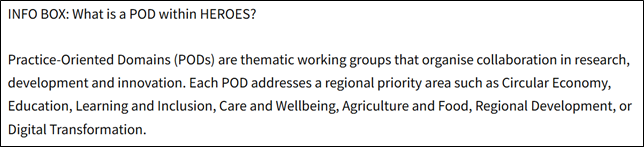
Viewed from this perspective, entrepreneurship functions as a horizontal capability within the alliance—one that can support stakeholder engagement, solution-oriented project development and sustainable regional impact.
Entrepreneurial expertise has always been present within HEROES institutions. What is changing is the degree of coordination between partners. Conversations that initially took place informally have developed into more systematic discussions on shared priorities, complementary strengths. HEROES is becoming aware of the role entrepreneurship can play in supporting the alliance’s long-term objectives.
Participation has also widened. What started as a dialogue among a limited number of specialists now involves several partner institutions. This reflects a growing recognition that entrepreneurial competences extend well beyond traditional business education. In many fields—from engineering to health and social care—entrepreneurial thinking contributes to innovation, problem-solving and collaboration with regional stakeholders.
Designing Entrepreneurial Learning
One of the central questions within Entrepreneurship@HEROES concerns the design of entrepreneurial learning. How can universities develop competences that remain relevant beyond individual courses or short-term projects?
At Thomas More, the EntreDesign Canvas provides a framework for addressing this question. The tool helps educators align learning objectives, teaching methods and assessment in a coherent way. Rather than treating entrepreneurship as a stand-alone topic, the model encourages integration across curricula.
Filip Burgelman from Thomas More emphasises that entrepreneurship education should not be understood too narrowly. “Entrepreneurship education is not only about launching start-ups,” he explains. “It is about developing initiative, resilience, and the ability to recognise opportunities—competences that are valuable in many professional environments.”
From this perspective, the goal is not merely to increase the number of student start-ups. Instead, the focus lies on long-term capability building. Entrepreneurial competences can be equally relevant in established companies and public organisations.
Evidence as a Foundation
Seinäjoki University of Applied Sciences (SEAMK) contributes to the collaboration through long-term research on entrepreneurial intentions. The findings indicate that entrepreneurship does not automatically emerge during higher education, but especially students’ self-efficacy can be supported. Institutional culture, role models, and offered support all influence how students perceive entrepreneurial careers.
Dr. Sanna Joensuu-Salo highlights the importance of measurement tools in this context. “Measuring entrepreneurial intentions and competences helps universities identify where development efforts are needed,” she notes. “By examining both student perspectives and staff attitudes, institutions can better understand how entrepreneurial culture evolves.”
Tools such as Entre Intentio and the Teacher Survey make it possible to monitor these developments over time. Combining student-level and staff-level data offers insight into both individual motivation and organisational readiness. Such evidence supports strategic decision-making and helps institutions track the impact of their initiatives.
Building Entrepreneurial Ecosystems
While research and education provide the foundation, entrepreneurship also depends on supportive institutional environments. Deggendorf Institute of Technology (DIT) offers an example through its 360° startup ecosystem, which integrates mentoring, incubation, and regional cooperation.
For Klaus Kandlbinder from DIT, the key to a successful ecosystem lies in consistency. “Entrepreneurial ecosystems require long-term commitment,” he explains. “Mentoring, incubation and regional partnerships need to work together within a clear organisational structure.”
When these elements are aligned, entrepreneurship becomes part of institutional culture rather than the result of isolated initiatives. Such ecosystem approaches provide valuable reference points for collaboration within the HEROES alliance.
A Horizontal Contribution to the Alliance
Within HEROES, Entrepreneurship@HEROES is currently exploring how entrepreneurial competences can support the existing PODs horizontally. Discussions have included conducting Entre Intentio and Teacher surveys across the alliance, joint staff development activities, blended intensive programmes, and possibilities for collaborative funding initiatives.
The underlying idea is pragmatic: rather than building a separate structure, entrepreneurship can reinforce work already taking place within the thematic domains. By sharing methods, tools, and expertise, the initiative can help strengthen innovation capacity throughout the alliance.
Looking Ahead
Entrepreneurship@HEROES is still evolving. Initiated by Thomas More and supported by experts from several partner institutions, the initiative demonstrates how bottom-up collaboration can shape the development of the alliance.
Its objective is not to create another organisational layer but to connect existing strengths and give them a clearer direction. In doing so, the initiative aims to strengthen the role of entrepreneurial competences within the broader HEROES strategy.
The next steps involve identifying concrete collaboration opportunities and further developing structured cooperation between partners. As the initiative continues to grow, its value will lie in connecting established expertise and supporting the long-term innovation capacity of the HEROES alliance.
Anne-Maria Mäkelä
Senior Advisor, International RDI and Networks
Seinäjoki University of Applied Sciences, Finland
Anmari Viljamaa
PhD, Principal Lecturer (Research) specialising in growth entrepreneurship and SME innovation capability
Seinäjoki University of Applied Sciences, Finland
Marc Clerkx
Entrepreneurship lecturer and business model innovation expert with strong experience in challenge-based education and SME collaboration
Thomas More University of Applied Sciences, Belgium