Beyond individual skills: Rethinking professional competence in applied gerontology
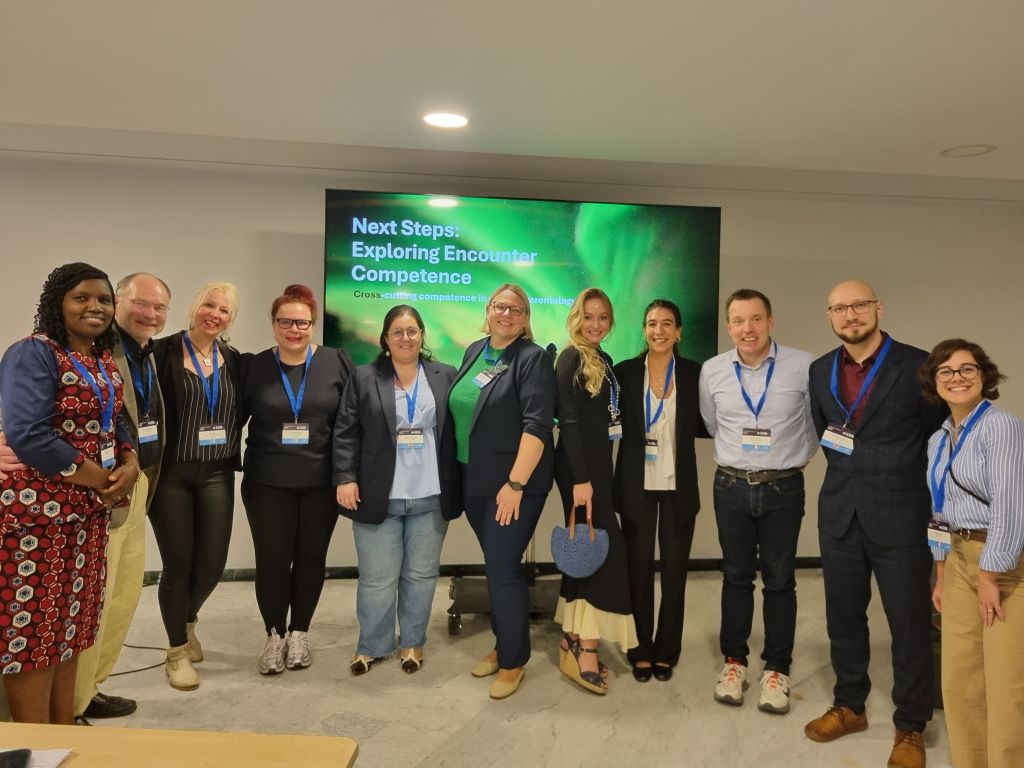
Greetings from beautiful Seville, Spain! At the 19th International Conference of Education, Research and Innovation (ICERI2026) we had the opportunity to present our work titled “Curriculum–Work Alignment and Future Competence Needs in Degree-Oriented Adult Education for Applied Gerontology: Evidence from a National Finnish Survey.” Our work is part of the GEROS project (2025–2027), a national collaboration aimed at strengthening professional competence and the quality of applied gerontology education in Finland.
But ICERI2026 offered much more than an opportunity to present our own work. Inspiring presentations, discussions and encounters with international colleagues encouraged us to look beyond familiar perspectives and reflect on our own work in new ways. One question seemed to connect our presentation with many of the ideas shared at the conference: What makes a professional truly competent?
In this article, we bring together perspectives from our own presentation and ideas shared by international colleagues, reflecting on how these insights have encouraged us to rethink professional competence, its development through education and, ultimately, its meaning in the everyday lives of older people.
Are We Preparing Professionals for the Realities of Working Life?
Digitalisation, increasing diversity, changing service structures and complex client situations are reshaping professional practice and challenging us to reconsider the competence needed in working life. The GEROS project’s national analysis has provided a foundation for examining gerontological competence and its future needs (Mähönen, Turunen, et al., 2026). In our presentation, we highlighted an encouraging finding: curriculum contents showed substantial alignment with competence requirements identified by working professionals. Future competence needs also appeared to build on existing expertise rather than introduce entirely new areas (Mähönen, Siira, et al., 2026).
For us as educators, this raises an important question: Is developing education primarily about adding new content, or should we place greater emphasis on helping students connect and apply what they learn and already know? A professional may understand the service system, recognise changes in functioning, and know the principles of self-determination. Yet real-life situations rarely present these as separate tasks or follow a fixed script. An older person’s needs, preferences, resources and circumstances must be considered together, often without a single straightforward solution. This is where professionals need to bring together different areas of knowledge and exercise professional judgement.
Knowledge Provides the Foundation, but Encounters Give It Meaning
In our ICERI2026 presentation, we explored two illustrative examples of how competence areas may play different roles in professional practice: broad-based gerontological expertise as a potential overarching competence and encounter competence as a potential cross-cutting competence (Mähönen, Siira, et al., 2026). Broad-based gerontological expertise brings together knowledge of ageing, health, functioning, social circumstances, individual resources and ethical principles. It provides a foundation for understanding the complexity of ageing and individual life situations. Encounter competence, in turn, shapes how this knowledge is applied in practice through listening, recognising individual experiences, supporting self-determination and exercising professional judgement.
These dimensions complement one another. Broad-based knowledge helps professionals understand an older person’s situation, while encounter competence enables them to recognise what truly matters to that particular person. However, recognising these competence areas is only the beginning. We must also consider how education can support their development.
Putting Learning into Practice: Why Conditions Matter
Several ICERI2026 presentations encouraged us to look beyond curriculum structures and consider how professional competence develops through meaningful learning experiences. Tasi and Osipovskaya (2026) highlighted the human dimensions of education, including agency, trust, dialogue, belonging and reflection. Postle et al. (2026) explored how degree programmes can be designed around authentic learning experiences rather than simply organising content and teaching hours. These perspectives also invite us to consider how professional learning continues beyond formal education. Through practical experience, professionals can deepen their understanding of individual situations, recognise what matters most and develop their professional judgement.
Although these presentations focused mainly on entrepreneurship and business education, we see their pedagogical perspectives as relevant to applied gerontology education as well. They encouraged us to consider how professional education can support not only the acquisition of knowledge and skills, but also the development of judgement, responsibility and professional identity.
Another inspiring example came from Dr. Benigno B. Agapito Jr. from the Philippines, who explored students as co-creators of knowledge in online learning. His presentation illustrated how student-generated videos can become valuable learning resources for others rather than simply assignments completed for assessment. We have explored a similar approach in the GEROS project, where students completing their practical training have created videos that have already been published as learning materials for an online course. This offers students an opportunity to reflect on their experiences and contribute to the learning of others. Liotino et al. (2026) presented another pedagogical approach, combining online learning, collaborative workshops and practical application in the workplace-based experimentation.
Together, these perspectives encouraged us to consider what kinds of experiences help students develop into reflective, responsible and capable professionals.
When Learning Meets the Realities of Working Life
Learning experiences alone, however, do not guarantee that new competence will become part of professional practice. Baranova and Surikova (2026) from the University of Latvia explored how instruments for evaluating the transfer of professional learning into workplace practice could be adapted to a national context. Research on learning transfer highlights the importance of organisational support, workplace conditions and opportunities to apply new knowledge (Nīmante et al., 2025).
A related perspective emerged from Sánchez-Urien et al. (2026), who examined lifelong learning practices in Spanish industrial organisations. Their findings highlighted positive aspects of organisational learning culture, including mutual respect and support, while identifying areas for development, particularly in learning from mistakes and evaluating learning outcomes. Although these studies were conducted in different professional contexts, they invited us to consider the conditions under which competence can be applied and developed.
These perspectives also made us reflect on encounter competence in gerontological practice. Understanding the principles of person-centred interaction does not automatically mean that professionals can consistently apply them in everyday encounters with older people. We believe that organisational environments, opportunities for reflection and established working practices also deserve attention when considering how encounter competence develops and becomes visible in practice.
Whose Knowledge Counts?
One particularly thought-provoking perspective emerged from Andreassen and Andersson (2026), who examined how knowledge gained through customer collaboration can contribute to organisational learning and innovation. Although their study focused on industrial organisations, it inspired us to ask: Whose knowledge shapes professional competence and practices in applied gerontology?
We often define and evaluate competence from the perspectives of education, professionals or organisations. Yet encounters with older people can challenge assumptions, reveal overlooked needs and offer new understanding. When recognised and shared, these perspectives may also contribute to the development of professional practices and services.
Our findings (Mähönen, Siira, et al., 2026) suggest strong alignment between education and the competence needs identified in working life. But should education only prepare professionals to meet today’s expectations, or also equip them to question and improve existing practices? And what if encounters with older people were not only opportunities to apply professional knowledge, but also a starting point for developing education itself? By involving older people in educational development, we can recognise them as partners in shaping what future professionals need to learn.
When Encounters Shape What We Know
The presentations and discussions at ICERI2026 encouraged us to take our own thinking further. In our work, we have explored broad-based gerontological expertise as an overarching competence and encounter competence as a cross-cutting competence. But what if their relationship is more dynamic than we initially considered?
Encounter competence may not only enable professionals to apply gerontological knowledge. Encounters with older people can also challenge, enrich and reshape that knowledge. In this way, broad-based gerontological expertise and encounter competence may continuously strengthen one another.
Perhaps this is what it means to move beyond individual skills: to recognise professional competence not simply as something we possess and apply, but as something that continues to develop through encounters with older people.
Hanna Mähönen
GEROS Project Manager, SEAMK
SEAMK
Kirsi Siira, GEROS Project Manager, SAMK
SAMK
References
Agapito, B. B., Jr. (2026, November 9–11). Students as co-creators of knowledge: A pedagogical multimodal analysis of student-generated creative works in open and distance e-learning [Conference presentation]. ICERI2026, Seville, Spain.
Andreassen, J. E., & Andersson, G. (2026, November 9–11). Open innovation for closed implementation of SDGs in SMEs: The role of boundary mechanisms in organizational learning [Conference presentation]. ICERI2026, Seville, Spain.
Baranova, S., & Surikova, S. (2026, November 9–11). Adaptation of learning transfer evaluation instruments for measuring the impact of professional development in Latvia [Conference presentation]. ICERI2026, Seville, Spain.
Liotino, M., Fedeli, M., & Schmidt, S. (2026, November 9–11 ). Designing blended learning for the twin transition: A mixed-method case study with small and medium-sized enterprises in the Veneto region [Conference presentation]. ICERI2026, Seville, Spain.
Mähönen, H., Siira, K., & Myller, T. (2026, November 9–11). Curriculum–work alignment and future competence needs in degree-oriented adult education for applied gerontology: Evidence from a national Finnish survey [Conference presentation]. ICERI2026, Seville, Spain.
Mähönen, H., Turunen, K., Arolaakso, S., Jumisko, E., Rolamo, M., Vahaluoto, S., Puustelli-Pitkänen, A., Siira, K., Teeri, S., Urtamo, A., Tenkanen-Salmela, R., Palpatzis, K., Myller, T., & Niemelä, T. (2026b). Geronomin ydinosaaminen ja tulevaisuuden osaamistarpeet: GEROS-hankkeen ydinainesanalyysin tuloksia ja suosituksia koulutuksen kehittämiseen. Kansallinen ikäosaamisen AMK-verkosto. https://www.theseus.fi/handle/10024/910939
Nīmante, D., Kokare, M., Baranova, S., & Surikova, S. (2025). Transferring results of professional development into practice: A scoping review. Education Sciences, 15(1), Article 95. https://doi.org/10.3390/educsci15010095
Postle, A., Tasi, P., Rasul, M., Vettraino, E., Berg, J., & Chapman-Lees, C. (2026, November 9–11). Designing beyond compression: Developing a new model for accelerated undergraduate business education [Conference presentation]. ICERI2026, Seville, Spain.
Sánchez-Urien, N., Echaburu Mulet, B., Sagarna Alvarez, A., & Castaño Benito, U. (2026, November 9–11). Understanding lifelong learning practices in industrial organisations: Evidence from a mature European manufacturing ecosystem [Conference presentation]. ICERI2026, Seville, Spain.
Tasi, P., & Osipovskaya, E. (2026, November 9–11). From learning outcomes to learning experiences: Reimagining the human side of education [Conference presentation]. ICERI2026, Seville, Spain.